Product Overview
|
The patented Pinnacle UltraTouch system has been
designed as a direct replacement for standard spring loaded mechanical palm buttons and is
designed to fit into existing operator palm button stations without modification.
The UltraTouch enclosure is a molded high strength
NEMA 4 polycarbonate module designed to meet the high impact and vibration requirements of
industry. The solid state electronics of the UltraTouch switch incorporates an
advanced redundant diverse sensor design. This means that each module has two different
sensors with isolated circuits along with a monitoring redundant circuit. The circuitry of
the UltraTouch is also designed to provide second-order failure protection. This gives
the UltraTouch an unparalleled level of safety and assurance against inadvertent
actuation, or failing in the "on" or conducting mode, which is a common problem found throughout industry
with competitive ergonomic switch replacements.
|
|
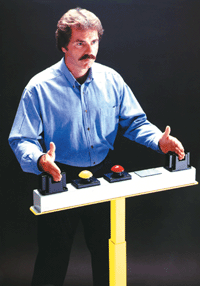
The UltraTouch design is so safe against inadvertent actuation, that two
UltraTouch modules when spaced and located properly in accordance to OSHA and ANSI hand control
distance formulas (the same formula is used for mechanical palm buttons), permit its use as an operator
safety two hand control device. The UltraTouch dual dissimilar sensor format is designed for the
machine operator to actuate the switch, and that no inadvertent foreign objects such as a sleeves, insects,
broomsticks, playing cards, rags, mists or droplets can activate or trigger the switch. This gives
UltraTouch an unparalleled level of safety while giving the operator the benefit of using the correct
ergonomic hand position of neutral, 0° deviation and 100% hand power.
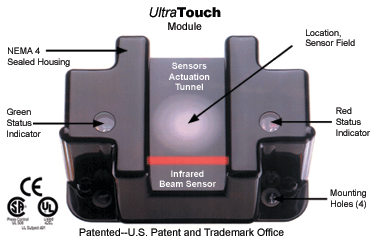
UltraTouch Configuration
The UltraTouch dual dissimilar sensor ergonomic palm switch is configured in the following
manner:
The U-shaped sensors actuation channel provides a triggering point for
the machine operators hand. This is where the invisible infrared light beam is located and is crossing the
channel. There is also a unique U-shaped location sensor mounted on the inside of the UltraTouch
enclosure that hugs the sensor channel and is insulated by the enclosure itself. When the machine operator
inserts their hand into the sensors actuation tunnel, both the infrared sensor and the location sensor must
be satisfied in order to energize an electromechanical relay to send a cycle start signal to the machine.
Both individual sensors within each module are time interlocked, and if both sensors are not triggered
concurrently by the operators hand, the UltraTouch output will be inhibited to the machine control.
The module also contains two visible LED indicators which informs the status of the UltraTouch module
to the operator. A green LED indicates that the relay contacts are closed, both sensors have been activated
and no failures have been detected. The red LED indicates that the relay contacts are open and no
satisfactory conditions were detected on both sensors. This advanced patented UltraTouch design is not
available on any competitive units and gives the UltraTouch user an unparalleled level of safety when
using ergonomic zero force actuation devices. Additionally, the operator will be activating the machine
properly by using the correct ergonomic hand position of neutral, 0° deviation and 100% hand
power.
Easy to Install
UltraTouch installs with ease and comes with complete installation instructions. Simple module design
permits direct exchange for existing spring loaded mechanical palm buttons and even utilize the existing screw
holes on the run bar. All systems have normally open (NO) and normally closed (NC) contacts, and are also available
in a four (4) pole wiring configuration depending on the machine control requirements. The ultimate in
versatility!
New installations and retrofit projects are completely installed in
minutes by a qualified electrician. Also supplied is a toll free 800 number if any questions should arise by
your installation personnel.
UltraSafe Design
Each UltraTouch switch module incorporates the following safety design features:
-
Two dissimilar sensors
- Infrared sensor
- Positive location sensor
- Redundant circuitry
- Chatter free design circuit
- Anti-noise circuit
- No false trip on power up circuit
|
- Captive contact safety relays
- Operator status indicators
-
Interlock circuit between the diverse
sensors
- Immune to EMI and RFI noise
- Immune to weld field interference
- Control reliable design
|
OSHA, ANSI CSA Standards
The mounting locations of UltraTouch must conform to all State, Province and Federal codes and all
regulations pertaining to the subject machine on which the UltraTouch is to be applied.
Point of Operation Guarding
The UltraTouch System is a machine cycle initiation component that is designed to be a two-hand control
device for the machine operator. If a point of operation guarding device is desired or required, please contact
your local Pinnacle distributor or the factory for devices to comply with ANSI B11.1 or the various OSHA
regulations.
(Below standards are only partial)
American National Standard B11.19-1990
4.2.4.2.3 Two-Hand Control Devices. The two-hand control shall be designed to protect each hand control
against accidental or unintentional operation.
The two-hand control shall have the individual operator's hand controls arranged by design, construction, or
separation to require the use of both hands to cycle the machine tool.
The two-hand control shall be designed to require concurrent operation of both the operator's hand controls to
cycle the machine tool.
If more than one operator is to be safeguarded by the use of two-hand controls, each operator shall have individual
operator's hand controls. The selection of the operator's controls shall be capable of being supervised by the
employer. Additionally, each selected two-hand control shall be concurrently operated before the machine tool is
cycled. The two-hand control system shall be designed and constructed so as to prevent cycling of the machine tool
if all the operator's stations are deselected.
The two-hand control shall be designed to require the release of all selected operator's hand controls and the
reactuation of all operator's controls before a machine cycle can be initiated.
4.2.4.3 Operation
4.2.4.3.1 It shall be the responsibility of the employer to ensure that the two-hand operating lever, trip, or
control device is installed, operated, and maintained in accordance with this standard.
4.2.4.3.2 The device shall be located at a distance from the nearest hazard such that the operator cannot reach the
hazard with a hand or other body part before cessation of motion of the hazardous portion of the machine cycle. The
two-hand operating lever trip, or control device shall require concurrent actuation of both of the operating levers
or hand controls to initiate a machine cycle.
4.2.4.3.3 The two-hand control device shall require the concurrent actuation of the operator's hand controls during
the hazardous portion of the machine cycle such that the operator cannot reach the hazard before the hazardous
motion has ceased.
OSHA Federal Register Section 1910.217
(v) Two-hand controls for single stroke shall conform to the following requirements:
(a) Each hand control shall be protected against unintended operation and arranged by design, construction, and/or
separation so that the concurrent use of both hands is required to trip the press.
(b) The control system shall be designed to permit an adjustment which will require concurrent pressure from both
hands during the die closing portion of the stroke.
(c) The control system shall incorporate an anti-repeat feature.
(d) The control systems shall be designed to require release of all operators' hand controls before an interrupted
stroke can be resumed. This requirement pertains only to those single-stroke, two-hand controls manufactured and
installed on or after August 31,1971.
(vii) The two-hand control device shall protect the operator as specified
in paragraph (c)(3(i)(e) of section 1910.217
(a) When used in press operations requiring more than one operator, separate two-hand controls shall be provided
for each operator, and shall be designed to require concurrent application of all operators' controls to activate
the slide. The removal of a hand from any control button shall cause the slide to stop.
(b) Each two-hand control shall meet the construction requirements of paragraph (b)(7)(v) of this section.
(c) The safety distance (Ds) between each two-hand control device and the point of operation shall be greater than
the distance determined by the following formula:
Ds=63 inches/second X Ts: where: Ds-minimum safety distance (inches): 63 inches/second=hand speed constant and
Ts-stopping time of the press measured at approximately 90 position of crankshaft rotation (seconds) .
(d) Two-hand controls shall be fixed in position so that only a supervisor or safety engineer is capable of
relocating the controls.
UltraTouch Patent Number 5,410,148 - U.S. Patent and Trademark
Office
|